
 15 Dec 2025
A visit to the Grand Egyptian Museum (GEM) and the Giza Pyramids is the cleanest “two-in-one” cultural day you can do in Egypt: the world’s most iconic ancient monument complex paired with a new, purpose-built museum experience designed to bring Ancient Egypt into sharp focus. The pyramids deliver scale, emotion, and that once-in-a-lifetime feeling. The museum delivers context—how people lived, worshiped, built, ruled, and remembered. Together, they turn curiosity into understanding.
Remal Sinai designs this Grand Egyptian Museum & Pyramids experience for travellers who want the day to feel easy: clear timing, comfortable transport, and a guide who can translate stones into stories—especially valuable for Russian-speaking guests who don’t want to miss the meaning behind what they’re seeing.
The Giza Plateau is the headline. The museum is the explanation. When you see the Great Pyramid of Khufu, you’ll naturally ask questions—How did they build this? What did it mean? Who worked here? What did they believe? The GEM answers those questions with a curated journey through artefacts, royal imagery, temples, and daily life, and it sits near the pyramids, so the two sites genuinely belong together.
This isn’t “museum plus monuments” as a random bundle. It’s a single narrative:
The pyramids show the ambition of the Old Kingdom in stone.
The museum shows the civilisation behind that ambition—across thousands of years.
A Giza Pyramids tour is not just a photo stop. It’s a landscape—wide desert space, sharp geometry, and the kind of silence that makes you speak more softly without thinking about it.
Most visitors focus on the “big three”:
The Great Pyramid of Khufu (Cheops) — the largest, and the one that defines the skyline.
The Pyramid of Khafre (Chephren) — often looks taller because of its position and surviving casing near the top.
The Pyramid of Menkaure (Mykerinos) — smaller, but powerful in presence.
Your guide’s job is to help you read the site: how the plateau was organised, why the pyramids are aligned, how causeways and temples fit into the layout, and what “royal eternity” meant in Ancient Egyptian thinking.
No matter how many photos you’ve seen, the Great Sphinx of Giza feels different in person. It’s both symbolic and practical: a monument carved from the landscape itself, placed in a complex of temples, causeways, and ritual spaces that shaped the visitor experience even in antiquity.
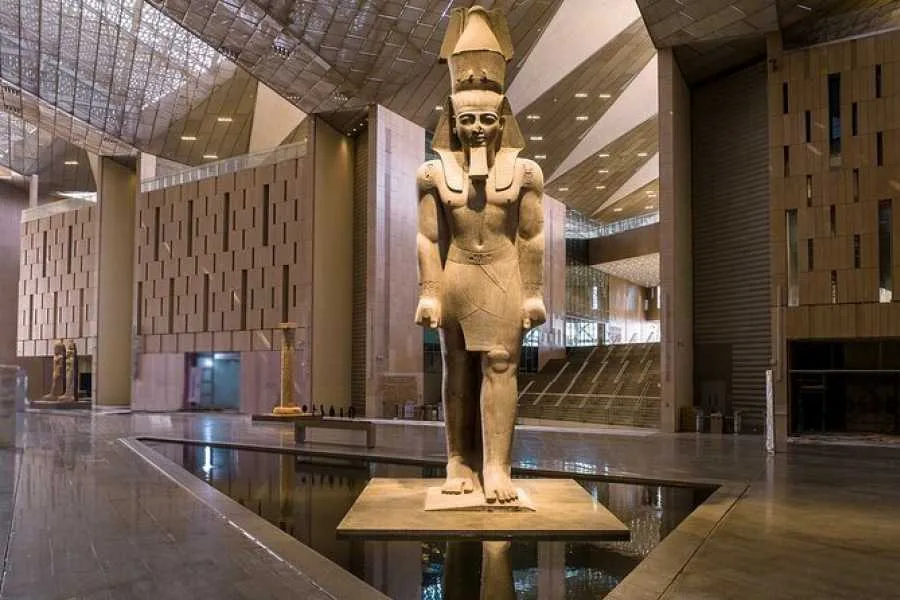
The Grand Egyptian Museum is not a renovation of an old building—it is a large, modern museum complex created specifically to present Ancient Egyptian material culture at scale, and it opened to the public in late 2025 after a long build and phased access.
International reporting describes GEM as a vast new institution near the pyramids with tens of thousands of artefacts on display, including major royal and monumental pieces.
One of the most satisfying things about visiting GEM on the same day as Giza is the continuity: you can be looking at ancient stone architecture in the morning and then, later, be inside a museum designed with direct visual and symbolic relationship to that landscape. Egyptian official communications have highlighted the museum’s location on the Giza Plateau area, close to the pyramids, as part of that concept.
GEM is frequently described as housing a very large number of artefacts—on the order of tens of thousands—presented with modern museum infrastructure and visitor flow.
The point is not only to see “famous objects,” but to understand:
how kings used imagery and inscriptions to project power,
how temples functioned as economic and religious centres,
how burial, memory, and ritual shaped art and architecture,
how everyday life looked in tools, textiles, and household objects.
If you’ve ever walked through a museum and felt overwhelmed, a guided visit makes the difference: you get a storyline rather than a warehouse feeling.
The museum publishes structured opening hours and last-entry times, and it also emphasises the importance of using its official ticketing channels. Your day plan should respect those times so you don’t end up rushing the museum portion.
A good Grand Egyptian Museum and Pyramids tour is not a sprint. The best version of this day is built around rhythm: focused time at the plateau, a clean transition, and a museum visit that gives you enough space to absorb.
A typical flow can look like this:
Early start to reach Giza before the day gets too crowded and the light becomes harsh.
Plateau time with multiple viewpoints: wide shots, closer angles, and time to understand the layout.
Sphinx and temple zone for the iconic face-to-face moment and deeper context.
Museum segment at GEM to connect the monument experience to objects, history, and meaning.
Return with a calm schedule—no last-minute panic.
This is exactly where professional coordination matters. When guests use our Transportation support, the day stays smooth from pickup to drop-off, and your energy goes into the experience instead of the logistics.
Many people visit Giza and remember “big stones.” People who visit with a skilled guide remember a civilisation.
An Egyptologist-style explanation helps you notice:
construction logic (ramps, quarrying, workforce organisation—what we know and what remains debated),
symbolism (solar cult links, kingship theology, afterlife beliefs),
the human side (workers’ lives, administration, craft systems),
how later periods reinterpreted earlier monuments.
It also helps you filter myths. Egypt attracts legends. A good guide gives you wonder without nonsense.
Both formats can work beautifully. The question is what you value most.
Private tour is ideal if you want:
flexible timing and photo stops,
a slower pace for families or older travellers,
privacy and reduced stress,
more time for questions and interpretation.
Small group works if you like:
a social feel without being crowded,
a structured itinerary,
efficient pacing.
If you want the “highest comfort” version—priority handling, extra flexibility, and discreet organisation—our team can layer in support through VIP Services, keeping the day premium without making it complicated.
A day around the pyramids and the museum is not extreme, but it is long enough that small choices matter.
Bring:
water and sun protection (hat, sunglasses, sunscreen),
comfortable shoes (sand and stone are not friendly to flimsy footwear),
a light layer (mornings and air-conditioned interiors can feel cooler than expected),
a phone power bank (you will take more photos than you think),
patience for the “wow” moments—because they deserve time.
Egypt is more enjoyable when you understand it. Russian-speaking guests often tell us they don’t just want “a driver and a ticket”—they want clarity: what they’re seeing, why it matters, and how to move through the day without stress.
That’s why Remal Sinai builds this experience around:
clear communication and scheduling,
knowledgeable guiding for monuments and museum context,
comfort-first pacing for families and mixed-age groups,
reliable coordination from pickup to return.
If you already know your travel dates and want a plan that fits your hotel schedule, the simplest way to start is to reach us via Contact Us and tell us the style you prefer—private, small group, museum-heavy, or pyramid-heavy—so the day matches your priorities.
At Giza, the best photos are usually the simple ones: wide frames that include desert space and pyramid lines, and close details that show scale. At GEM, gallery layouts are designed for flow, so it helps to decide in advance whether you want a “highlights” visit or a slower, story-led visit with time for questions. Comfortable pacing also means planning short shade breaks and using the museum segment as a cooler, quieter reset after the plateau.
Yes—when the schedule is built properly and the day starts early. The key is pacing: enough time at Giza to feel it, then enough time at GEM to understand it.
Absolutely. The museum turns the pyramids from “impressive” into “meaningful,” because you connect monuments to the civilisation that produced them.
Yes. Families often prefer a private pacing so children can rest, snack, and reset without pressure. The museum portion is also a good “cooler” segment after sun exposure.
You can visit independently, but guided context helps you see patterns and narratives rather than disconnected objects, especially in a museum described as presenting tens of thousands of artefacts.
Some travel days are enjoyable. This one is formative. The pyramids give you the shock of scale—how humans could build something so bold and so enduring. The Grand Egyptian Museum gives you the story behind that shock: the faces, beliefs, skills, and systems that powered one of the world’s most influential civilisations.
When the day is coordinated professionally, it doesn’t feel like “two attractions.” It feels like one complete narrative—Egypt, explained in the place where the story was written.


